
The 2-Minute Rule Will Help You Actually Raise Bilingual Kids (When Everyone Else Is Procrastinating)
Table of contents
You want to raise a bilingual child/ trilingual child/ multilingual child – you know all the benefits that being multilingual brings, and you want to give your child that precious gift.
You genuinely care about it.
But somehow, days go by… weeks go by…
And you forget to speak the target language.
Or you’re tired.
Or you’re busy.
Or English is simply easier.
So you tell yourself, “I’ll start properly next week.”

If that sounds familiar, this post is for you.
Because the problem isn’t motivation.
And it’s definitely not that you don’t care.
The real problem is that starting can feel overwhelming.
And in this post, I want to show you how to break that cycle – with just two minutes a day.
If you’re new here, welcome. My name’s Ka Yee. I'm a Chartered Translator based in the UK. My husband and I have been raising our children to be trilingual for nine years, and my book Bilingual and Trilingual Parenting 101 has helped thousands of families around the world. I know these struggles intimately – because I’ve lived them.

1. Why parents get STUCK – and why this is really a HABIT problem
Most parents who want bilingual or multilingual children have great INTENTIONS.
But why do so many of them get STUCK?!
They get stuck because life is busy, routines are chaotic, and the target language starts to feel like extra work layered on top of an already full day.
So what happens?
You forget to speak the language.
You feel guilty.
You try again… then stop.
You decide you’ll “do it properly later”.
That cycle repeats – and each time it does, starting feels even more overwhelming.
Eventually, many parents don’t just pause; they quietly give up.
For a long time, my husband and I were stuck in exactly the same loop. We blamed ourselves. We blamed our child for not “wanting” to speak our languages. We assumed we were doing something wrong.
But looking back, the issue was much simpler – and much more solvable.
This wasn’t a language problem or a motivation problem.
It was a habit formation problem.
When I re-read Atomic Habits by James Clear, something clicked. The frustration so many bilingual parents feel isn’t because they don’t care enough – it’s because they’re trying to start with habits that are simply too big to sustain.
Quick disclaimer: some parents DO NOT STRUGGLE at all speaking to their children in the target language all the time. It is definitely doable.
In fact, when we tried to overcome our challenges three years into our trilingual parenting journey, we did NOT really use a gradual approach – acting on our friend's advice, we intensively "trained" our child to reply to us in our languages and, YES IT WORKED, But it's NOT for everyone.
I wrote this post to encourage parents who are intimidated by the all-or-nothing approach. When I re-read Atomic Habits and came across the 2 minute rule, it was like a lightbulb went off in my head and I thought that the rule could DEFINITELY help parents in this situation.
2. The 2-MINUTE RULE explained (and why it works for parents raising bilingual/ trilingual kids)
The 2-minute rule is simple.
The basic premise is this: if a habit feels too hard to start, you’re thinking too BIG.
Imagine deciding to train for a full marathon by running 26 miles on day one. Most people would collapse, feel defeated, and give up entirely. But if you start with 20 or 30 minutes a day and build slowly, the habit has room to grow.
The same logic applies to bilingual/ trilingual/ multilingual parenting.
Instead of asking, “How do I raise a bilingual child as quickly as possible?”
You ask, “What’s the smallest action that gets me moving?”

Two minutes is short enough that your brain doesn’t panic.
It can’t say, “I don’t have time.”
It doesn’t trigger excessive resistance.
And while two minutes might feel insignificant, it’s powerful enough to break the cycle of non-action and create momentum.
This matters for your child too.
Speaking the target language all the time can feel overwhelming for them as well.
Two minutes a day is manageable, predictable, and non-threatening – a good start!
I’ve used this principle in other areas of my life. When I committed to exercising daily, I started with just seven minutes a day (a fellow mum who was in great shape after 3 kids introduced me to Lucy Wyndham-Read's 7-minute workouts). That didn’t feel intimidating, so I stuck with it. Over time, as the benefits built up and the habit became enjoyable, those seven minutes naturally turned into twenty.
You don’t need to do MORE (for now).
You just need to START.
3. How to APPLY the 2-minute rule to bilingual parenting
Here’s how this works in real life.
Starting tomorrow, commit to speaking to your child in the target language for two minutes a day – no more, no less. During those two minutes, encourage your child to reply in the target language too.
Breakfast is an ideal place to start.
It happens every day.
Your child needs something (food!) from you.
You’re both relatively fresh, not exhausted from the day.
For two minutes at breakfast:
You speak only the target language
Your child asks in the target language

No worksheets.
No flashcards.
Nothing complicated.
At a bare minimum, insist on “please” and “thank you” in the target language.
If that’s all that happens, it still counts. That is a win.
The goal here is not fluency.
The goal is a pattern interrupt.
Right now, English is the default. It happens automatically. A pattern interrupt breaks that autopilot and creates a new association:
Child wants something → uses the target language → gets a positive outcome.
Once that interruption happens – even for two minutes – a new habit finally has space to form.

4. WHY THIS WORKS long term – plus one SIMPLE HACK that makes it stick
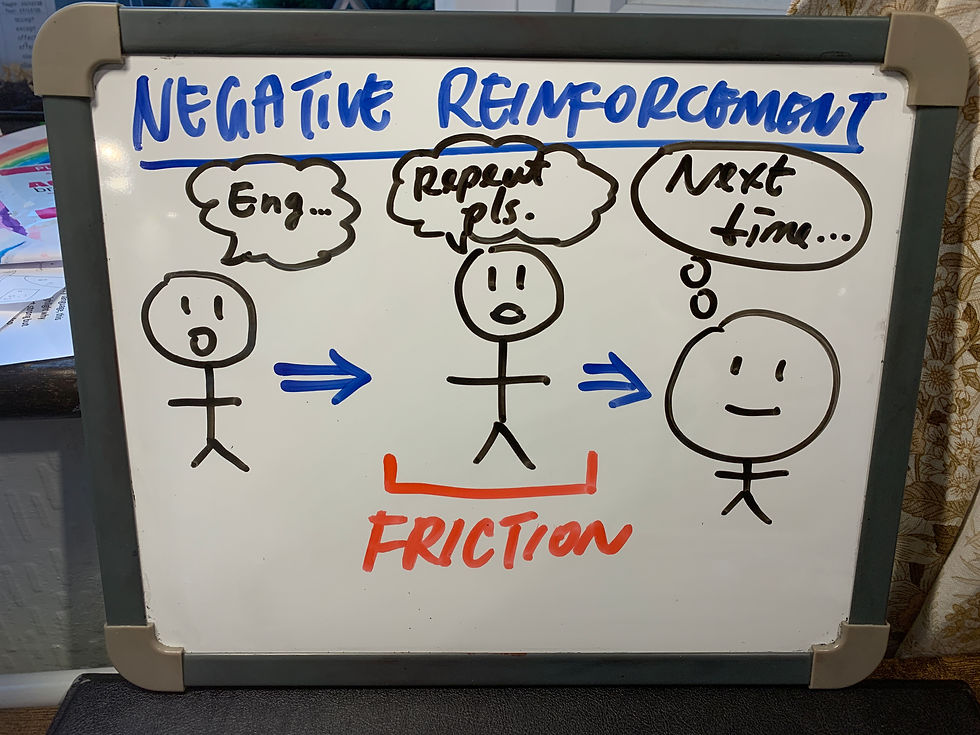
This approach works because it uses both positive and negative reinforcement in a calm, non-emotional way.
When your child uses the target language, the reward is immediate:
they get your attention
they receive praise
they get what they want
Their brain quickly learns: “Using this language leads to good outcomes.”

At the same time, the competing habit is gently weakened.
When your child uses the majority language, you don’t punish or scold them.
You simply add a tiny bit of friction by asking, “Can you say that in the target language?”
Even insisting on “please” or “thank you” is enough.
Over time, the brain naturally chooses the more convenient option – using the target language first – to avoid having to repeat itself. Gradually, the default begins to shift.
Extra hack: make progress visible
One thing that helps both you and your child stick with this is a visual progress tracker.
This doesn’t need to be fancy. A calendar on the fridge, a simple chart, stickers, ticks, hearts – whatever your child responds to.
Each day you manage your two minutes, mark it.
For your child, this creates a sense of achievement.
For you, it removes the vague feeling that “nothing is happening”.
Each mark becomes a tiny reward. You start thinking, “Let’s not break the chain.”
Over time, something deeper shifts too. You’re no longer a parent who is trying to raise a bilingual child. You’re a parent who shows up consistently – even if it’s just for two minutes.
Action creates proof.
Proof reinforces identity.
And that’s how lasting change happens.

Comments