
How to Teach Your Child Two (or More) Languages – What Parents Really Mean (and What Actually Works)
- Ka Yee Meck
- Jan 30
- 7 min read
“How do I teach my child two – or even three – languages?”
This is one of the most common questions I get, both here on the blog and in the comments on my YouTube channel. And it’s a great question. But it’s also one that often hides two very different intentions.
In this post, I’m going to explain the difference between teaching a language and raising a bilingual or trilingual child, and then walk you through practical, realistic ways to do both – including how we do it in our own family.
If you’re new here, welcome. I’m Ka Yee – a UK-based mum and Chartered Translator. My husband and I have been raising our children to be trilingual in Mandarin, Russian, and English since 2016. For the past nine years, we’ve lived this journey day in, day out. My book Bilingual and Trilingual Parenting 101 has helped thousands of families around the world, and everything you’ll read below comes straight from real life.
Let’s start by clearing up what parents usually mean when they say:
“How do I teach my child two languages?”
What parents usually mean by “teaching” two languages
In my experience, parents usually mean one of two things.
Meaning 1: Raising a child bilingually or multilingually
This is where a language is used for daily communication, not something you sit down and “teach”.
In our family, my husband speaks to the children exclusively in Russian, and I speak to them exclusively in Mandarin. These languages are embedded into our daily life, not something we do in addition to it!

Meaning 2: Teaching a second or third language in addition to the main language
This is very different.
Imagine a family in the US where both parents are native English speakers, but they speak decent Spanish. They want their child to learn Spanish because it’s useful. English remains the main home language, but Spanish is taught intentionally through books, songs, games, and structured activities.
Both approaches are valid. Both can work. And importantly – they can be combined. In fact, that’s exactly what we do.

But they work in very different ways, which is why understanding the difference matters.
Model 1: Raising your child bilingually (or trilingually)
Let’s start with the first model.
This is when a language is not taught explicitly, but acquired naturally through daily interaction. From a language-development point of view, this is called language acquisition, not language learning.
Children acquire language through meaningful, repeated interaction, not through instruction.
Think about how you learned your first language. No one sat you down and explained grammar rules to you as a baby. You absorbed language through constant exposure, need, and use. By the time formal teaching started at school, you were already fluent.
That’s exactly how this model works.
Practical tips for Model 1
If this is the approach you’re leaning towards, here are some practical ways to make it work.
1. Give each language a clear role
Sit down with your partner and decide:
Who speaks which language to the child?
When is it used?
Where is it used?
Some families use one parent–one language (this is what we do). Others use one language at home and another outside. Some use time-and-place strategies.
Any approach can work if it’s applied consistently.
2. Consistency
While it's not possible to be consistent ALL the time, the more consistent you can be, the better, generally speaking.
If mum speaks language A and dad speaks language B, stick to it.
Avoid flipping languages mid-conversation. Try not to “forget” to use the target language when you’re tired or busy.
This is about habit formation. The more consistent you are, the sooner your child will internalise the language.
I've made a video series exploring how to apply James Clear's principles of habit formation from Atomic Habits to multilingual parenting – check it out!
3. Be patient – progress can feel slow
This model can be used from birth, but it requires patience.
Most children don’t start speaking until after 12 months, which means you might be putting in a lot of effort for over a year before you see obvious results! That can feel frustrating, but your child is absorbing far more than you realise.
Language input is never wasted.
Model 2: Teaching a second or third language
Now let’s talk about the second model – teaching a language intentionally.
In this model, you don’t use the target language for daily communication. Instead, the language is introduced at specific times through structured activities such as reading, singing, or lessons.
Many parents assume this model only works with older children, but that’s not true. You can start teaching a second language from the baby years – just without formal instruction.
Practical steps for Model 2
Action step 1: Define what “teaching” looks like in your family
Be clear about:
Who is doing the teaching?
What language is being taught?
When does it happen?
How is it taught? Books? Songs? Classes?
For example, going back to that hypothetical American family teaching Spanish: they might read Spanish picture books from infancy, introduce Spanish nursery rhymes, and teach Spanish vocabulary alongside English.
English remains the language of daily life. Spanish exists in defined spaces.
As the child gets older, they might attend a weekend language school or study the language formally at school – giving them a huge head start compared to peers.
Action step 2: Gather the right resources
Having good materials makes a huge difference.
Picture books are an excellent starting point, especially those that introduce everyday vocabulary. Word books, posters, audio-supported materials, and videos all help build input.
At home, we rely heavily on books and visual resources to support intentional teaching sessions.
Shameless plug: Check out the bilingual picture book series my sister and I have created, designed for bilingual families!

Action step 3: Create a simple plan and routines
A plan doesn’t need to be complicated. For a three-year-old, it might look like:
15 minutes of reading together in the target language each evening
A weekly themed session (songs, games, even TV time)
Short, predictable routines work far better than ambitious plans that never happen.
Action step 4: Implement consistently
Short and frequent sessions beat long, irregular ones.
Fifteen minutes a day, most days of the week, is a great starting point. Older children can handle longer sessions, but consistency always matters more than duration.
A crucial point about reading and writing
Speaking can develop through interaction, play, and exposure.
Reading and writing cannot.
They always require intentional teaching – whether from you, a teacher, or a school. From the beginning, it’s worth thinking about whether you want your child to speak only, or also read and write in the target language. That decision will shape your approach.
How the two models overlap – our family example
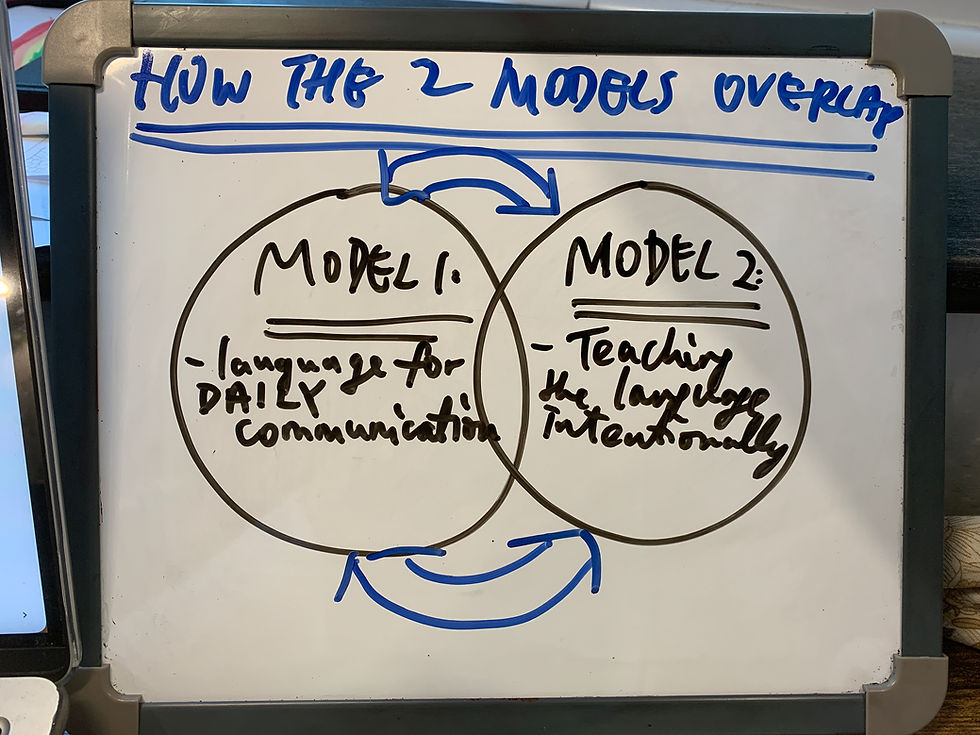
These two models are not opposites. They support each other.
In our family, we raise our children trilingually through daily communication. But we also teach reading and writing intentionally.
Each day, our children do structured reading and writing sessions in Mandarin and Russian. They also attend weekend Russian school, which boosts vocabulary and literacy further.

More recently, we’ve introduced Mandarin Netflix shows as a supplementary tool. I was initially sceptical, but used thoughtfully, TV can reinforce language exposure. What I don’t recommend is using screens as your child’s primary language teacher.

If you want a full break down of how we teach our kids reading and writing in our languages, check out my blog post and video on that subject!
How to decide what’s right for your family
If you’re wondering which model – or mix – makes sense for you, start with these questions.
1. How comfortable are you really in the target language?
If you’re a native speaker or highly fluent, Model 1 is incredibly powerful. If you’re less confident, Model 2 may be more sustainable.
Fluent non-native speakers can use Model 1 successfully – I’m living proof of that (long story short: I have near-native but not quite fully native-level proficiency in Mandarin) – but sustainability matters.
2. How much time and energy do you realistically have?
Model 1 integrates into daily life. Model 2 requires extra time and planning.
Choose an approach you can maintain long-term, not one that looks good on paper.
But... Relax! Remember: nothing here is irreversible. You can adjust, change direction, and evolve as your family’s circumstances change.
Final thoughts
There is no single “right” way to raise bilingual or trilingual children. There is only what works for your family, at this stage of life.
If you enjoyed this post, you’ll love the next one where I share nine practical tips you can use from day one to raise a bilingual baby.


Comments